

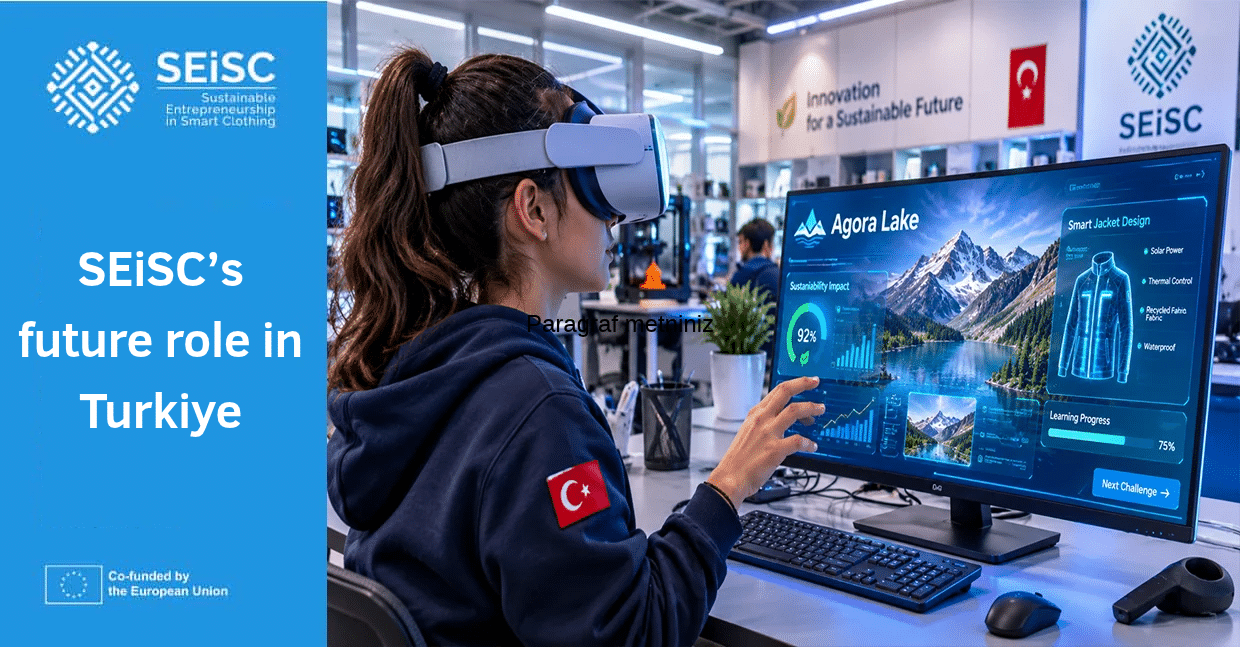
Although the SEiSC project officially came to an end in October 2026, the key question for vocational education in Turkiye is no longer what the project achieved, but how these achievements can be sustained. The national conferences held at Ankara made the project’s deliverables tangible: a competence framework, a teacher MOOC, and an AI-driven simulation. For Turkiye, SEiSC’s future role is clear: it must serve as the digital and pedagogical backbone for integrating sustainable entrepreneurship into the national VET curriculum, particularly within the textile and smart clothing sectors.
The Turkish Potential: From Pilot to Policy
Turkiye is uniquely positioned to leverage SEiSC’s results. As a major player in the global textile and apparel industry, the shift toward circular economy and smart clothing is not just an environmental imperative but an economic one. Ortaköy 80. Yıl MTAL, as the Turkish partner, has already demonstrated the viability of this approach through student video workshops on innovative business ideas. However, to move from isolated pilot projects to systemic adoption, Turkiye must capitalize on the two primary outputs designed to reach distinct target groups: the MOOC for teachers and the Agora Lake platform for students.
Reaching Teachers: The MOOC as a Catalyst
The SEiSC MOOC, hosted on Open Academia, is a five-hour, self-paced course that bridges the gap between traditional teaching and the digital-green transition. For VET teachers, this is a critical resource. The course translates the European frameworks—DigCompEdu 2.0, GreenComp, and EntreComp—into practical classroom methodologies.
The Ministry of National Education (MEB) should consider integrating the SEiSC MOOC into the mandatory in-service training catalog for vocational teachers in the textile and fashion departments. Although more than 100 teachers have already registered on the platform and received their certificates upon completing the training, Turkiye needs to increase these figures in order to establish a ‘community of practice’, as outlined in the project’s sustainability objectives. By offering the MOOC locally and providing certification recognized by MEB, Turkiye can ensure that teachers are not just aware of smart clothing concepts but are equipped to teach them using inquiry-based and adaptive learning methodologies. The inclusion of AI literacy in the MOOC makes it particularly relevant for modernizing the Turkish VET landscape.
Engaging Students: The Agora Lake Simulation
While the MOOC prepares the instructor, the Agora Lake simulation engages the student. As detailed on the project’s serious games page (games.seisc.eu), Agora Lake is not a linear quiz but an adaptive learning journey. Set around an alpine lake threatened by textile waste, students act as consultants for “EcoTrack Solutions.” The platform’s AI analyzes responses in real time, identifying the type of mistake (e.g., a purely economic reading of sustainability) and providing formative feedback. If a student struggles, the system provides a guided activity to reframe the concept rather than letting them move forward with a misunderstanding.
Agora Lake is a robust tool for developing critical thinking and Design Thinking skills. Turkish schools should utilize this platform to supplement the existing curriculum, particularly in the “Business Model Canvas” and “Sustainability” units. Since the platform is available free of charge ,schools in Turkiye can adopt it without significant financial burden. Furthermore, the competitive nature of the simulation, where students work in teams to achieve high scores in areas like “Sustainable Business Models,” aligns well with the Turkish education system’s growing emphasis on project-based learning and gamification. Teachers should be encouraged to use the “Teacher Dashboard” to monitor progress and intervene when students are struggling with complex concepts like the Triple Bottom Line.
Utilizing the Project’s Results: A Strategic Roadmap
To ensure wider adoption, Turkiye should systematically utilize the resources available under the “Results” tab on the SEiSC website (seisc.eu). Based on the project’s outputs, here is a recommended roadmap:
- Localization of the Competence Framework : The “Framework of Competences for Students’ Sustainable Entrepreneurial Mindset” is currently available in English. The first step for Turkiye is to translate and adapt this framework into the Turkish language and align it with the MEB’s existing vocational qualification framework. This ensures that the skills students acquire in Agora Lake are formally recognized.
- Institutionalizing the Adaptive Teacher Guide : The “Adaptive Teacher Guide,” finalized in the summer of 2026, provides practical guidance on teaching sustainable entrepreneurial mindsets. Turkish VET institutions should use this guide to establish “Innovation Labs” or “Smart Clothing Clubs” within schools. The guide’s focus on Design Thinking and Inquiry-Based Learning can be used to mentor teachers who wish to replicate the success of the Ortaköy students’ video projects.
- Leveraging the Community of Practice: The project aims for 100 members in its Community of Practice. Turkiye should host national workshops, similar to the “Training the Trainers” event held in Helsinki, to foster a local network. By bringing together teachers from different provinces who have completed the MOOC, Turkiye can create a peer-support system where educators share their experiences with the Agora Lake platform and discuss how to integrate the “Circular Smart Jersey” lesson plans into their classrooms.
The future role of SEiSC in Turkiye is that of a bridge. It connects the theoretical ambition of the Green Deal with the practical realities of the classroom. By adopting the MOOC as a standard training tool for teachers and Agora Lake as an engaging, adaptive learning environment for students, Turkiye can ensure that the project’s impact outlives its 2026 expiration date. The tools are built; the challenge now is to embed them into the fabric of Turkish vocational education, transforming students from passive learners into the sustainable entrepreneurs that the smart clothing industry urgently requires.