

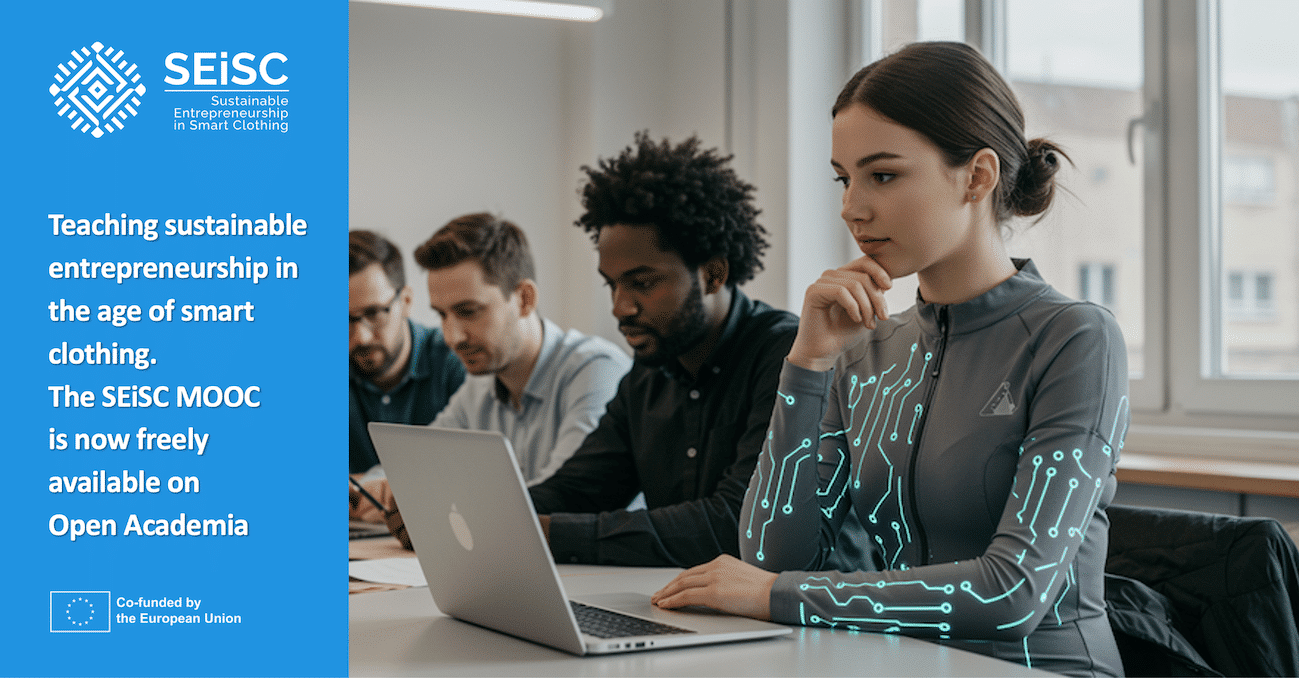
The SEiSC MOOC, developed by nine partners across six European countries, is now freely available for VET teachers on Open Academia
A T-shirt that monitors your heart rate. A fabric that adjusts to body temperature. A jacket that collects biometric data in real time. The smart clothing market is already worth billions and growing at a pace most industries can only envy. Yet in vocational classrooms across Europe, the subject is barely mentioned. And when it does, the tools to teach it well are rarely there.
That gap, between what the market demands and what vocational education currently delivers, is precisely where SEiSC begins.
A European partnership with a practical goal
SEiSC (Sustainable Entrepreneurship in Smart Clothing) is an Erasmus+ project that brings together nine organisations from six countries: Finland, Italy, Spain, Turkey, Ireland and Bulgaria. The coordinating body is LHKK, Lounais-Hämeen koulutuskuntayhtymä, a Finnish vocational institution with deep experience in professional education. The project is not, strictly speaking, about smart clothing technology. It is about something considerably harder: equipping VET teachers with the knowledge and methods to develop a sustainable entrepreneurial mindset in their students, using the smart clothing sector as the lens through which to do it.
The underlying argument is straightforward. If you want to change what students learn, start with the people who teach them.
Ten modules, six countries, one shared framework
The most tangible outcome of this work is now live. The SEiSC MOOC is freely available on Open Academia and offers ten training modules totalling five hours of learning, each developed by one of the project’s partners.
The course is built around three European competence frameworks: EntreComp for entrepreneurial skills, GreenComp for sustainability, and DigCompEdu for educators’ digital competences. These are not decorative labels. They function as a shared grammar running through every module, ensuring coherence across what is otherwise a genuinely diverse set of contributors and national contexts.
The journey begins with adaptive teaching, introduced by Euro Education Bulgaria, which gives teachers a structured approach to reading their classroom in real time and adjusting their practice to individual student needs. From there, the course moves through inquiry-based and game-based learning (Ortakoy and USR), the fundamentals of sustainable entrepreneurship in the smart clothing sector (Praktica), the practical frameworks for teaching entrepreneurial and green competences in the classroom, from the Business Model Canvas to the EntreComp and GreenComp tools (LHKK), the pedagogical use of virtual simulations and extended reality (3DBear and TU Dublin), and digital pedagogy applied to VR environments (OpenCom). The final module, developed by Cellini, focuses on reflective practice, formative assessment and adaptive feedback. For a course built on the idea that failure is part of learning, it is a fitting place to close.
What changes for the teachers who take it
A VET teacher who completes the SEiSC MOOC does not walk away with a certificate to file and forget. They leave with approaches they can use the following day in class. That distinction matters more than it might seem. Continuing professional development for teachers tends to be abstract, disconnected from daily practice and difficult to transfer. This course was designed to work the other way around: every module is grounded in real competences, uses concrete examples from the sector and proposes methods that do not require expensive equipment or advanced technical knowledge.
That holds for the module on XR simulations, which maps out accessible routes for teachers who have never used a headset. It holds for the Business Model Canvas module (LHKK), which translates a management tool into a replicable classroom practice. And it holds for adaptive teaching, which does not ask teachers to reinvent themselves, but to give a name and a method to something many of them are already doing.
How to access the course
The SEiSC MOOC is free, delivered in English and open to VET teachers across Europe. It is available on Open Academia at https://openacademia.eu/courses/seisc-course .
For those who want to explore the wider project, access additional materials or follow future developments, the official project website is seisc.eu.